
Él y Ella Is Coming to Camp
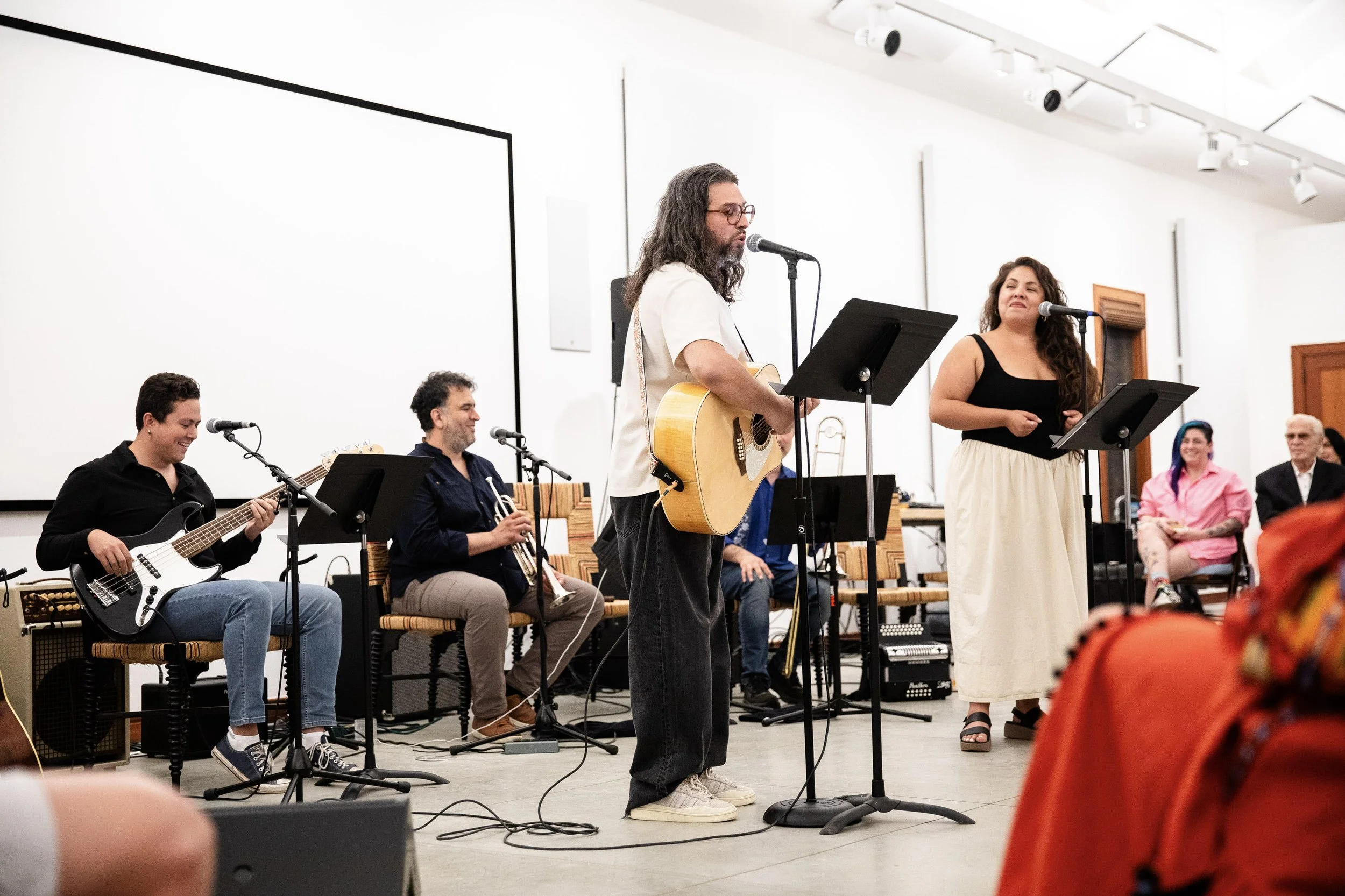
2026 Guild Hall William P Rayner Artist-in-Residence - Jaime Lozano, Florencia Cuenca & Adrian Alexander Alea
Photography: Jessica Dalene
Jaime Lozano, Florencia Cuenca, and Adrian Alexander Alea bring their new musical to Drama Club Camp for an intensive Commercial Takeover
This summer, the artists behind Él y Ella are leaving the starts, stops, commutes, and calendar gymnastics of city development behind.
Writers Jaime Lozano and Florencia Cuenca, director Adrian Alexander Alea, and their collaborators will gather at Drama Club Camp in Mount Vernon, Maine, for an intensive developmental workshop devoted entirely to the next chapter of their new musical.
The residency is presented by Drama Club in partnership with Straighten Your Crown’s Development Initiative and will lead to a free public performance at Lincoln Center’s David Rubenstein Atrium this December.
Inspired by the true story of two Mexican artists who fall in love and move to New York on a whim, Él y Ella is both a romantic comedy and an immigrant story. It follows a couple building a life through art while remaining connected to their roots and raising their Mexican American son.
The musical’s vibrant Spanglish score draws from mariachi, cumbia, ranchera, corrido, and norteña traditions and is performed by four multi-instrumentalists. The result is a story that is deeply personal and culturally specific, but expansive in its questions: What does it cost to build a life as an artist? What do we carry with us when we leave home? And how do love, family, ambition, and identity evolve when they all have to share the same small New York apartment?
For us, Él y Ella represents exactly where the musical goes next.
It is joyful, theatrical, emotionally direct, and unmistakably born from the lives of the artists creating it. It also arrives at Camp with a formidable development history, including support from The Johnny Mercer Writers Grove at Goodspeed Musicals, Guild Hall’s William P. Rayner Artist-in-Residence program, The Ground Floor at Berkeley Repertory Theatre, and Rhinebeck Writers Retreat.
Now, the team is ready to put the entire musical under one roof.
The Commercial Takeover
Drama Club’s Commercial Takeover model is designed to replace fragmented development with immersion.
Instead of squeezing rehearsals between other jobs, losing hours to transportation, or stopping just as the room begins to unlock something important, the full company takes over our 65-acre campus. Writers, directors, performers, musicians, and designers eat together, work together, and remain in conversation with the musical throughout the residency.
The goal is not simply to generate pages. It is to create the conditions for meaningful leaps.
“At Drama Club, we are committed to giving extraordinary artists the time, space, and support they need to create work at the highest level,” says Drama Club Founding Artistic Director Shannon Morrison. “Él y Ella is exactly the kind of musical we want to champion: deeply personal, joyfully entertaining, culturally specific, and universally relatable. Bringing this team together in an immersive environment gives them the freedom to move faster, dig deeper, and arrive in New York with the strongest possible version of the show.”
Director Adrian Alexander Alea will lead the staging and narrative work during the residency. He joins Lozano and Cuenca alongside musicians Yahir Montes, Hugo Moreno, and George Sáenz; choreographer William Carlos Angulo; Mexican music producer and longtime Lozano collaborator Demián Cantú; and cinematographer Julian Alvarez.
A Partnership Built for the Next Step
The takeover also marks a new partnership between Drama Club and Straighten Your Crown’s Development Initiative.
Led by Nicole LaFountaine, Straighten Your Crown provides the commercial infrastructure and management expertise necessary to help ambitious new work move from development toward large-scale production. Its nonprofit Development Initiative centers the belief that artists should receive a living wage while creating.
That combination makes the partnership a natural one: Drama Club creates the environment for focused artistic acceleration, while Straighten Your Crown helps build the bridge toward the musical’s commercial future.
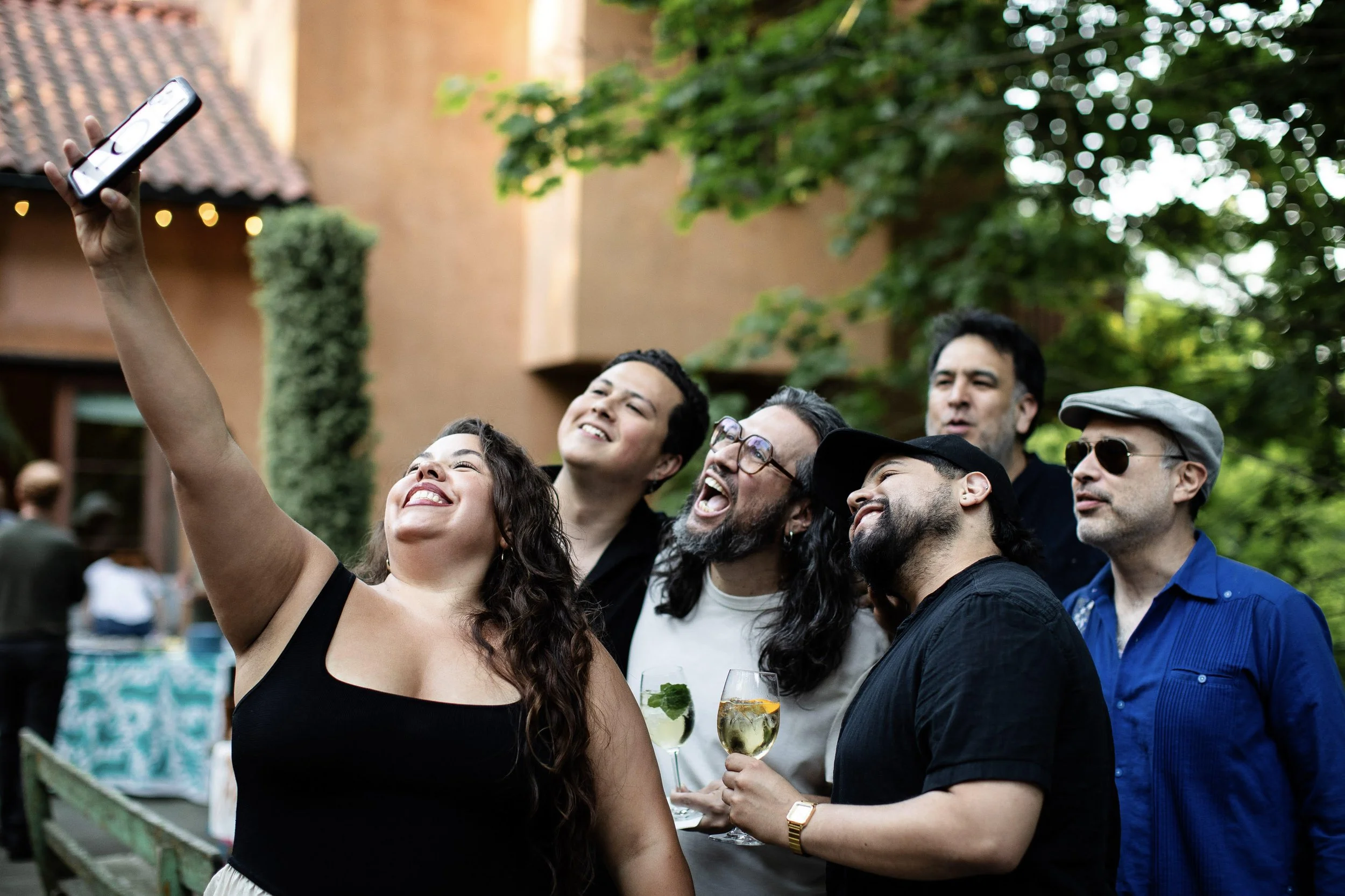
2026 Guild Hall William P Rayner Artist-in-Residence - Jaime Lozano, Florencia Cuenca & Adrian Alexander Alea
Photography: Jessica Dalene
Meet the Artists
Mexican musical theatre writer, composer, director, and activist Jaime Lozano has been described by Lin-Manuel Miranda as Broadway’s “next big thing.” His work includes El Otro Oz, Carmen La Cubana, Children of Salt, A Never-Ending Line, Desaparecidas, ROJA, and the developing Frida, The Musical. His albums with Jaime Lozano & The Familia include three volumes of Songs by an Immigrant, and his film work includes orchestrations for In the Heights.
Florencia Cuenca is a Mexican immigrant actor, singer, writer, and director whose work spans theatre, television, music, and concert performance. She originated the role of Estela in the Broadway production of Real Women Have Curves, becoming the first Mexican immigrant to originate a leading role on Broadway. Her directing credits include Desaparecidas, A Never-Ending Line, and ROJA, and her album Broadway in Spanglish was released by Concord Theatricals Recordings.
Together, Lozano and Cuenca founded The Familia, an organization dedicated to creating community and artistic opportunities for Latiné and immigrant artists.
Adrian Alexander Alea is a Latiné director and creative producer working across theatre, film, and live events. A 2026 Drama League Directors Project recipient and Helen Hayes Award nominee, his work has been seen or developed with The Public Theater, INTAR, The New Group, Repertorio Español, Lincoln Center Presents, Paper Mill Playhouse, New York City Center’s Encores!, NBC, and others.
This summer, they bring all of that experience, history, music, and possibility to Torsey Lake.
Then, this fall, Él y Ella heads to Lincoln Center.
That is the journey we built Camp for.
From first draft to first preview. From Torsey Lake to Times Square. Drama Club is where the musical goes next.
Where The Musical Goes Next: Our 2026-2027 Slate
We have been building toward this moment since the day we opened Drama Club's doors.
Not toward any one show. Toward a body of work — a constellation of projects that, taken together, say something about where we believe the American musical is going, and who we believe should be telling its stories.
Today, we're sharing our full 2026–2027 slate. Five projects. Two in active development. Three in production. All of them, in our view, essential.
The Productions
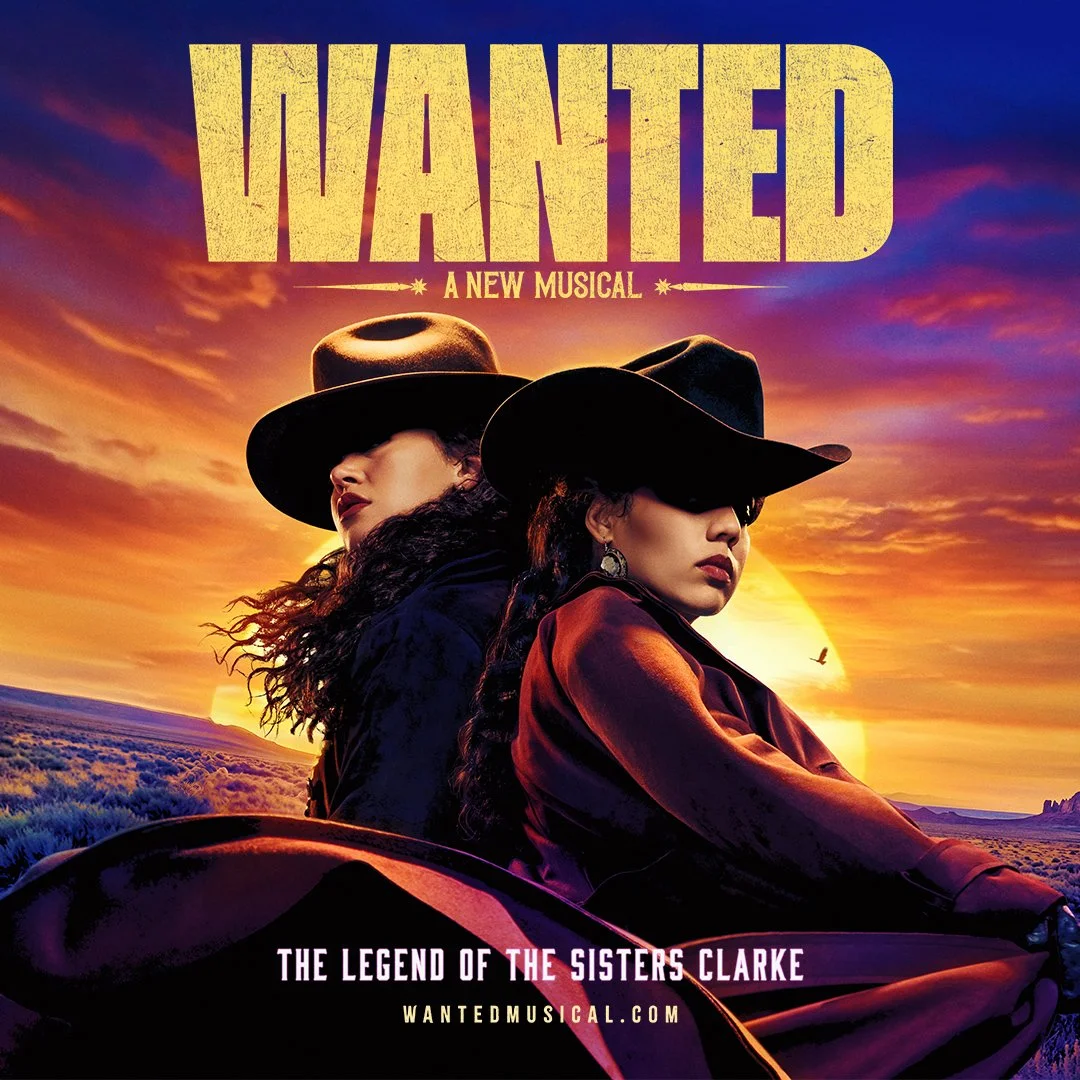
WANTED — Broadway, November 2026
WANTED is the story of Mary and Martha Clarke — Black twin sisters in 1890s Texas who passed as white and became outlaws in the Wild West to save their family. It is an American family legend: a story of sisterhood, loyalty, survival, and the choices we make when everything is on the line.
This show has earned everything it's about to receive. A sold-out run at Signature Theatre. A New York Times Critic's Pick at Paper Mill Playhouse. A dynamic, contemporary score that has generated extraordinary audience response at every stage. And now, a Broadway debut featuring Grammy Award-winner Ledisi alongside Liisi LaFontaine — two powerhouse performers bringing the Clarke sisters to life on the Great White Way.
WANTED centers Black women, stars Black women, and was written by a Black woman. It is claiming space on Broadway. We are proud to help it get there.
THE HEART — Off-Broadway, October 2026 / Broadway, Spring 2027
When a young surfer's life is cut short, a heart begins its 24-hour journey toward a stranger — and toward the possibility of saving them. The Heart follows that journey, and the lives it touches along the way.
The creative team alone would make this a must-watch: book by Kait Kerrigan, a thrilling electronic score by Anne and Ian Eisendrath, choreography by Mandy Moore, and direction by Tony Award-winner Christopher Ashley. The world premiere at La Jolla Playhouse in 2025 sold out and extended twice. Junkyard Dog Productions — the team behind Come From Away — are leading it to New York.
We believe in this show with our whole, well, heart.
DIRTY DANCING — N.A. Tour, August 2026 / Broadway, January–June 2027
The story that awakened a generation is back — reimagined for a new stage, with a completely new vision from acclaimed director Lonny Price. Based on the beloved Lionsgate film, Dirty Dancing: The Musical brings Baby and Johnny back to life in a production built for the road and bound for Broadway.
The model here is one we find compelling: a North America tour, a limited Broadway run, and then the tour continues. The built-in audience is enormous. The new creative vision gives it something fresh to offer them.
THE INTERESTINGS — Berkeley Rep, January 2027
Sara Bareilles. Meg Wolitzer. Sarah Ruhl. Michael Arden. If you stopped reading there, you would already understand why we're in.
The Interestings — adapted from Wolitzer's beloved novel — follows six friends across several decades, exploring art, money, and the friendships that define us. With music and lyrics by Bareilles (whose last musical, Waitress, recouped in under ten months), a book co-written by the novel's own author, and direction by a Tony Award-winner, this is one of the most anticipated new musicals in the pipeline. We are investing now to position Drama Club as a co-producer on the Broadway production.
The Development Projects (Pre-Broadway)
DISCOVERY — In Development
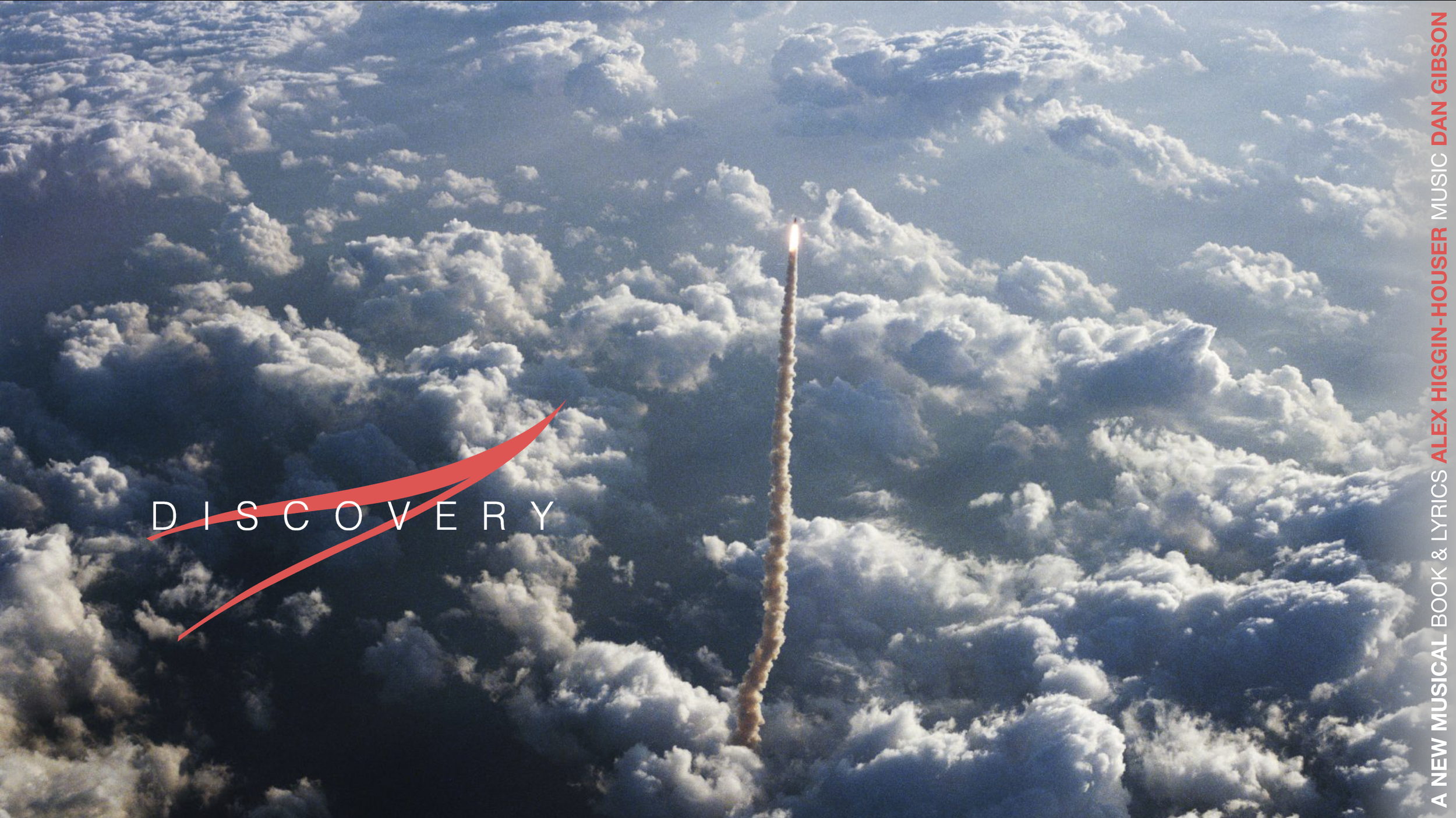
Discovery tells the story of the NASA astronaut corps in the aftermath of the 1986 Challenger tragedy — and the long, painful road back to the 1988 launch of Space Shuttle Discovery. At its center is Dr. Sally Ride: iconic astronaut, queer outsider, truth-teller.
Writers Alex Higgin-Houser and Dan Gibson had the audacity to dream this show into existence — and to go speak directly to the astronauts who lived it. The result is an entirely original, prestige score in the tradition of Ragtime or Carousel, with an ensemble-driven story in the spirit of Come From Away. Drama Club is the lead producer, and we are raising the initial capitalization for what we believe will be a landmark production with a Broadway future.
We still remember where we were when Challenger exploded. We think others do too.
THE ASCENDANTS — In Development
The Ascendants is something different.
An immersive rock musical — words by Shannon Morrison, music by Stephen M. Barnett — it plunges audiences into the heart of The Seraphim, a contemporary cult promising ultimate perfection through radical enlightenment. The score draws from Radiohead, NIN, The Killers, and The Doors. The experience blurs the line between theatre and something far more unsettling.
Immersive theatre remains one of the most underexploited frontiers in our field. The thriller genre is underproduced. And audiences are hungry for experiences that don't just ask them to watch — but to participate, to question, to feel genuinely unsafe in the best possible way.
Drama Club is the lead producer. We are developing this from the ground up, and we believe it will find its audience in a significant way.
Why We're Sharing All of This
We present our full slate because Drama Club is about more than any one show.
Our value — and our values — are determined by the constellation of work we choose to champion. Each of these projects reflects something we believe about where the musical is going: toward new stories, new voices, new forms, and new audiences.
A Strange Loop.MEXODUS.CATS: The Jellicle Ball. Those weren't accidents. They were choices — made early, made with conviction, and made in partnership with writers and producers who share our vision for what this art form can be.
This slate is the next chapter of that vision.
Most producers wait to see where the musical is going. We decide.
If you're a writer wondering whether Drama Club is the right home for your work — we hope this slate tells you something about who we are and what we believe in.
If you're a producer or partner looking for collaboration — let's talk.
If you're an investor ready to be part of where the musical goes next — we'd love to share more.
Drama Club is Where the Musical Goes Next. We are both the destination and the pathway.
The Pipeline is Real: What the CATS Tony Nominations Mean for Drama Club

The Tony nominations just dropped, and seeing our names and CATS: The Jellicle Ball on that list feels like a massive yaaaaaaas for everything we’ve been building.
For a long time, when people talked about Drama Club, they used words like "program" or referred to us as “those guys with Camp”. It’s understandable - Torsey Lake is our heart and soul. But we’ve always known we were building something much more aggressive than a summer retreat. We’ve been building a pipeline.
From Torsey to the Tonys
Let’s be real: the word "program" sounds static. It sounds like something that has a start date, an end date, and a certificate of completion. That’s not us.
Drama Club is an engine. We’ve spent the last few years quietly constructing a developmental ecosystem that doesn't just help artists - it launches them. We aren’t just a destination for writers to hide away in Maine; we are a commercial force designed to identify, commission, and propel the most transgressive work in the industry toward the center of the cultural conversation.
Why The Jellicle Ball matters to Drama Club
There’s a specific question I keep hearing: "If CATS didn’t start at Torsey, how is it a Drama Club show?" The answer is simple: The Pipeline isn't just about where a show starts; it’s about where we take it. Our involvement in The Jellicle Ball was a strategic choice. This production represents the exact DNA of what we do at Torsey: it’s brave, it’s queer, it’s inclusive, and it’s fundamentally radical. By putting the Drama Club name and our commercial weight behind it, we proved that our "camp" methodology—the belief that theater should be transformative and daring—has a massive, award-winning appetite on Broadway.
The Proof is in the Nominations
Today’s Tony nominations aren't just a win for a single production. They are a proof of concept. From the groundbreaking success of A Strange Loop to the current momentum of The Jellicle Ball, the pattern is clear.
We’ve created a bridge between the raw, experimental energy of our residency and the high-stakes world of commercial producing. That bridge is the Drama Club Pipeline. * We identify the work that actually matters.
We provide the "commercial muscle" to get it seen.
We make sure the industry looks different by the time we’re done.
What’s Next?
We aren’t just fans showing up to an awards ceremony this year. We’re architects. We are proving that you can take the spirit of a Maine cabin and turn it into the toast of the Tonys.
The road from Torsey to the Tonys is officially open, and honestly? The pipeline is just starting to flow. See you at the ceremony.
Outcomes: What Writers Learned at the DRAFTS Readings
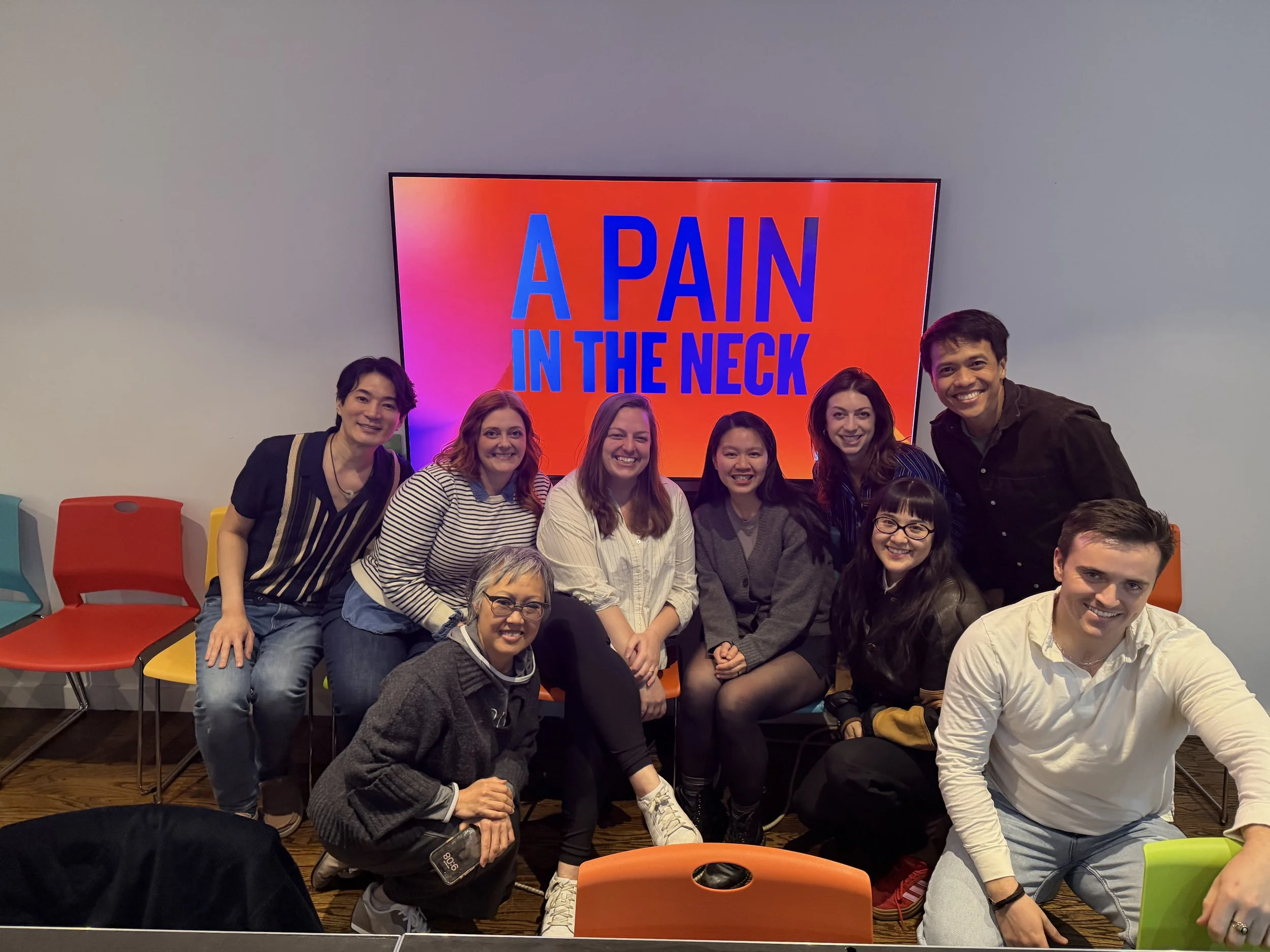
The energy in the room during our recent series of DRAFTS readings was nothing short of electric. For a creator, there is no moment quite as vulnerable - or as vital - as the transition from a private script to a living, breathing performance.
At Drama Club, we created DRAFTS to be a sanctuary for one of the most vulnerable parts of the creative process… the very first reading. We asked our writers to share their takeaways from the experience, and the sentiment was clear: to build something great, you first have to be brave enough to let it be heard.
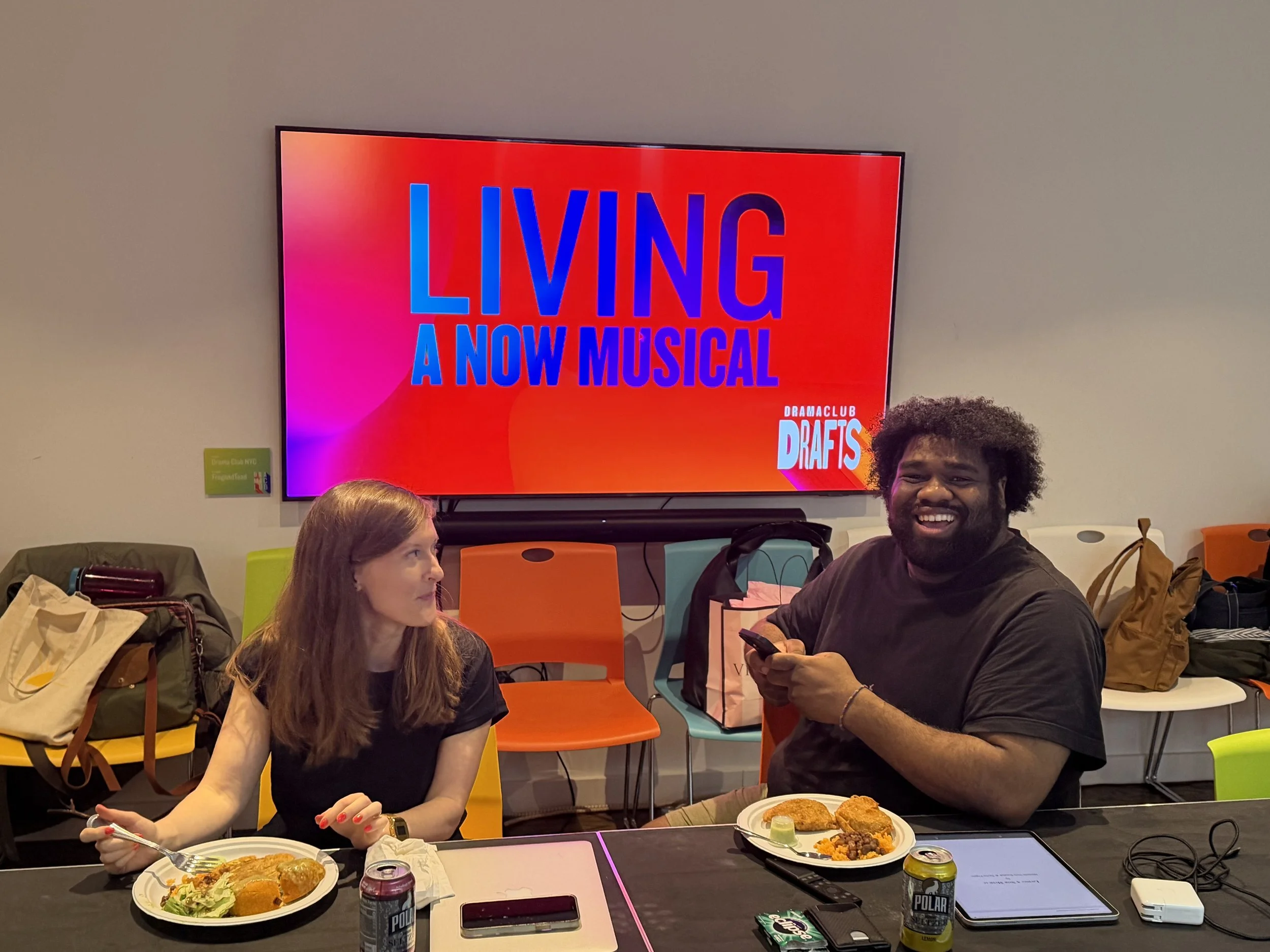
LIVING: Proving the Impossible Concept
For Michelle and Taylor, the reading served as a vital "proof of concept" for a deeply emotional premise.
The Big Question: They set out to see if it was possible to write a life-affirming musical about suicide. The reading confirmed that the story and characters deeply moved the audience.
A Foundation of Trust: Knowing the core emotional beats land allows them to move forward with confidence.
The Roadmap: Hearing the work aloud helped them identify repetitive elements in the score and pinpoint exactly which character decisions need more development.
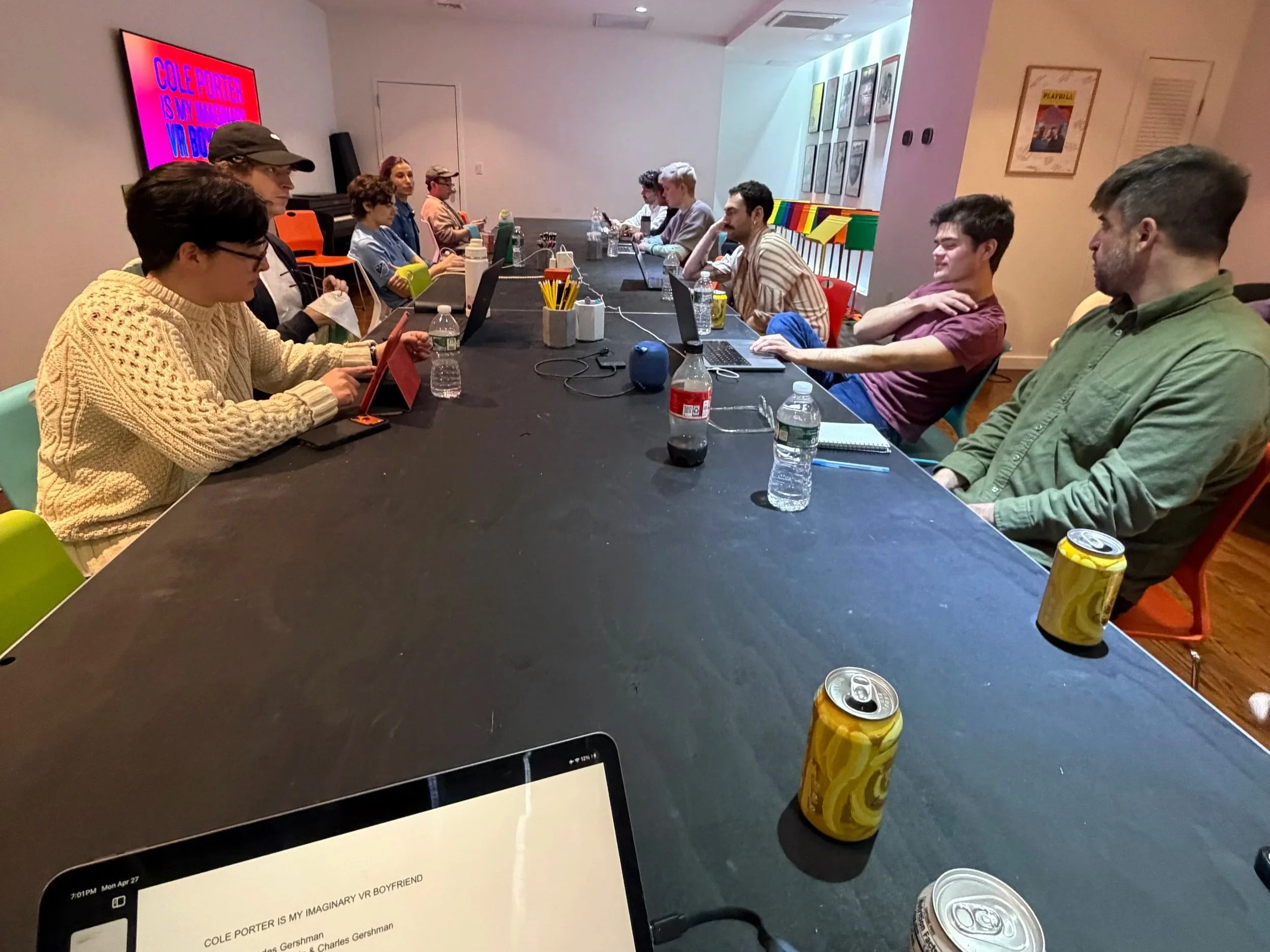
COLE PORTER IS MY IMAGINARY VR BOYFRIEND: Bridging the "Head-to-Page" Gap
Dylan and Charlie used the reading as a diagnostic tool for their show’s unique blend of VR, "gay pop escapism," and complex character arcs.
Clarifying the World: They realized how much lore was living in their heads but hadn't yet made it onto the page.
The Power of Tone: Testing "disjointed styles" of music helped Dylan see exactly what resonated, helping them "song-spot" to ensure future writing won't be cut as the story evolves.
The Evolution: The focus now shifts to making the audience care more deeply about the protagonist's addiction spiral while keeping the tone "quirky, eccentric, and strange."
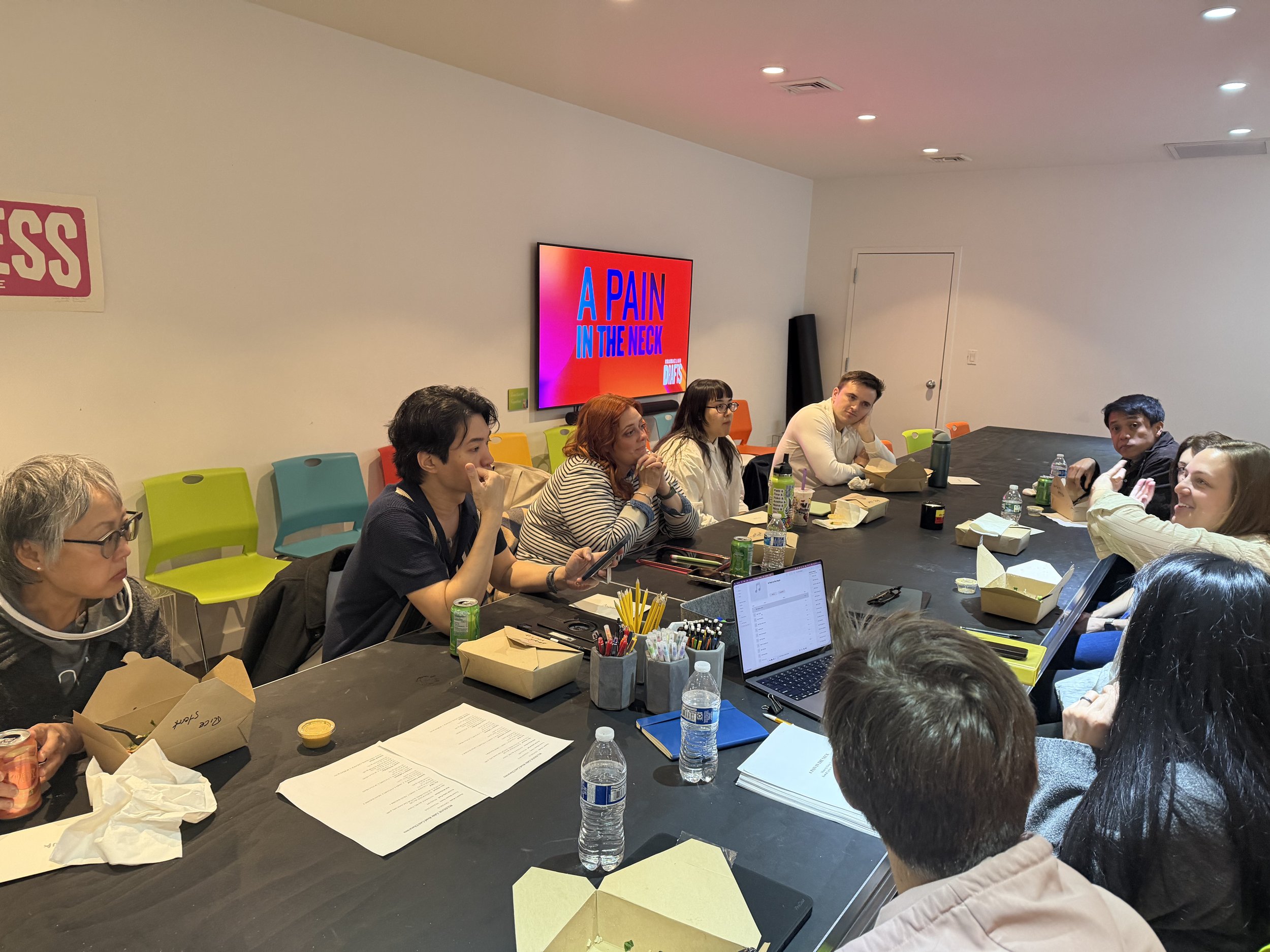
A PAIN IN THE NECK: The Freedom to Fail
For Zonia and Erin, the most liberating part of the process was the environment of Camp itself. Sometimes, the most helpful thing a writer can hear is that a first draft is supposed to be rough.
Safe Spaces: Knowing they were in a room where they were "allowed" to have a bad draft helped Zonia focus on the heart of the story rather than the fear of perfection.
Sparkles of Belief: Zonia highlighted how the simple act of being supported by the Drama Club community provides the fuel to keep fighting in a challenging industry.
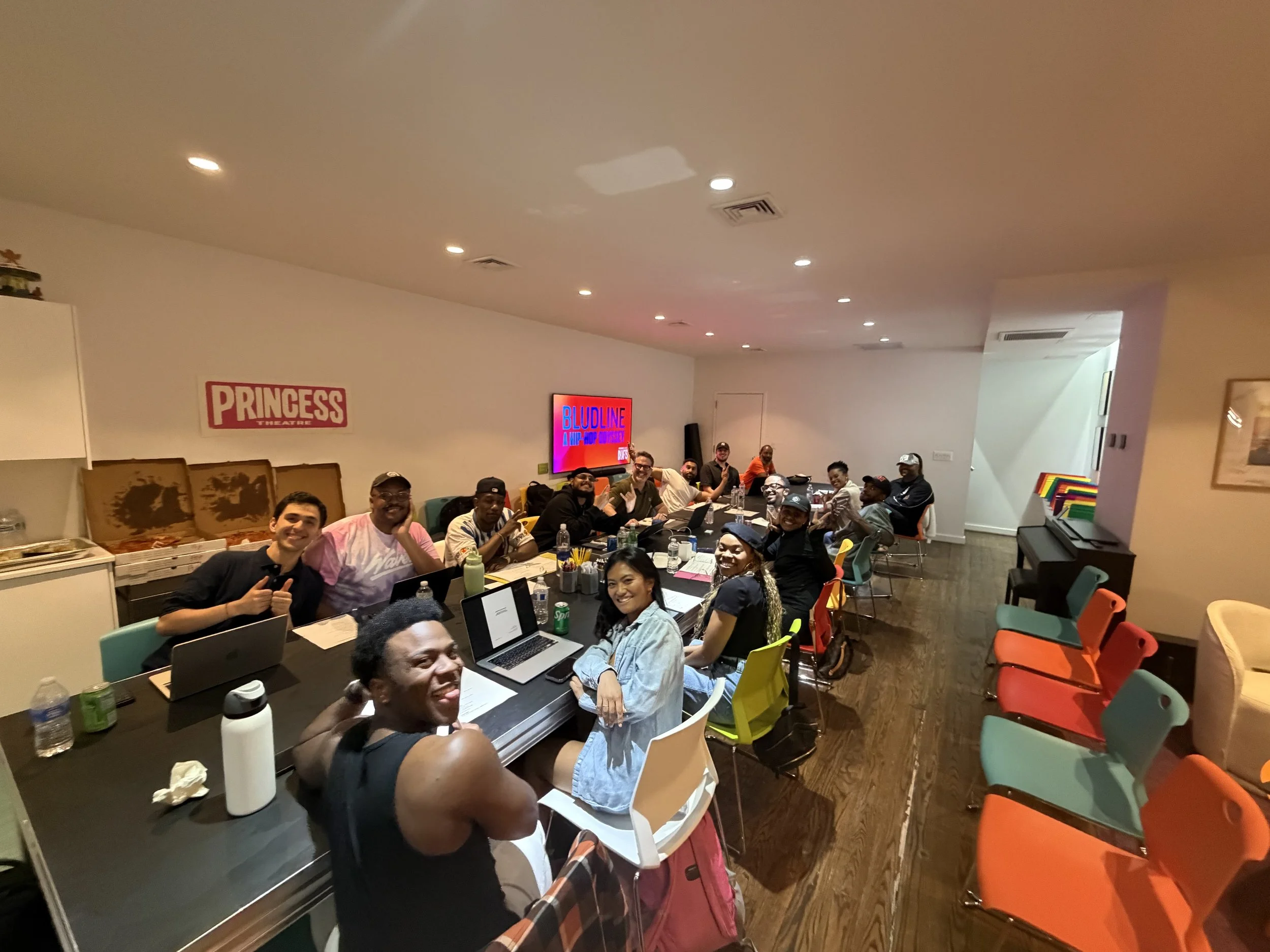
BLUDLINE: Refining the Rhythm
For Pete and Fermin, the reading was a celebration of vernacular and flow. The session provided a clear technical roadmap for their hip-hop-influenced project:
Expanding the Score: The feedback confirmed they could add more singing without losing the "hip-hop" edge.
Reclaiming Gems: The actors’ performances reminded the writers of scenes and characters they had previously cut that might actually deserve a second chance.
What’s Next?
The Drafts aren't just one-off events; they are catalysts. For these projects, the clock is now ticking toward some major milestones:
All four teams will be Writers-In-Residence at Drama Club Camp this summer, where they will spend a week at our 65-acre lakeside campus refining their work.
Charlie and Dylan are marinating in the feedback and preparing for another reading in July before a public presentation in the fall.
Fermin and Pete recently won the Richard Rodgers award and are currently working on that presentation.
And the work persists!
A massive thank you to the actors and the writers for trusting us with their work. Writing is a lonely business—until the room lights up. Congratulations to all involved. We hope this program proves to be an accelerator to the development of these shows!
Drama Club Launches International Fellowship. O’NEILL and SAVAGE Named Inaugural Recipients
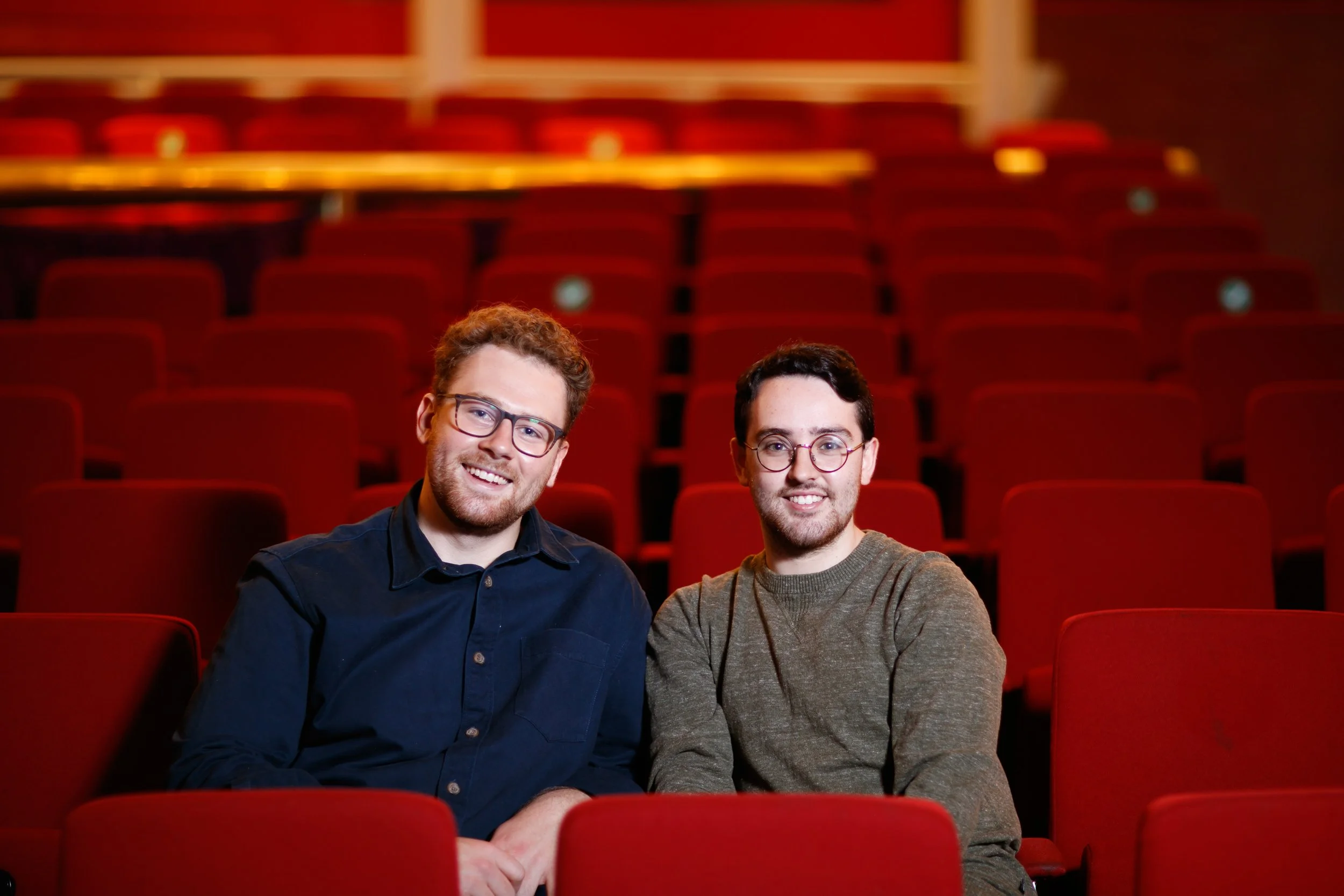
NEW YORK, NY — Drama Club is proud to announce the launch of the Drama Club International Fellowship, a prestigious global initiative designed to supercharge the careers of emerging musical theater creators. This high-status appointment provides elite international talent with a direct pipeline into the heart of the American theater industry.
The Drama Club International Fellowship gives one exceptional non-US team per year an intensive, two-phase residency experience with the purpose of advancing both the creative work and the professional networks of these gifted artists. The program begins with a creative residency at Drama Club Camp, where the fellows write and develop new work alongside a curated cohort of American peers; it then culminates in a career accelerator week in New York City at Drama Club’s West 43rd Street studio.
The inaugural recipients of the Drama Club International Fellowship are the Scottish duo Jonathan O’Neill and Isaac Savage. Jonathan and Isaac are an award-winning musical theatre writing duo based in Glasgow, recently recognised as “a writing duo to watch” by The Stage. The pair began working together in 2017 after having met at the Royal Conservatoire of Scotland and have been collaborating ever since. Their credits include: Jack and the Beanstalk: A New Mooosical (Dundee Rep), Stay (A Play, a Pie and a Pint) at Òran Mór, Glasgow and Traverse Theatre, Edinburgh; Belongings (The Minster School, Southwell); The Great Elf Escape: LIVE (Fearless Players/The Ayr Gaiety); Tanya and Bon Appétit (Royal Conservatoire of Scotland).
Their adaptation of Jack and the Beanstalk recently played to raves at Dundee Rep, which is where West End director Stephen Whitson first worked with the duo. That collaboration led Whitson to share their work with Drama Club, wondering how we could engage. “I knew that the work of Jonathan and Isaac was special, and that if anyone could help them hop the pond and find a way to develop their community in the States, it was Shannon & Scott at Drama Club,” says Whitson.
"This new International Fellowship is about more than just travel and time; it is a career-defining 'power-up' for the most promising voices in the global theater scene," says Shannon Morrison, Drama Club’s Founding Artistic Director. "By bringing O’Neill and Savage to Camp and then introducing them around the theatre players of Hell’s Kitchen, we are fostering a unique cross-pollination of style and perspective that can only happen within the Drama Club ecosystem.”
The Fellowship is designed to bridge the gap between foreign success and the NYC theater market, providing the network, the space, and the creative "clubhouse" necessary to mount a career on a global scale.
A Full Circle Moment

If you want to know where my obsession began, you have to go back to the first show I ever saw. It was CATS. I didn't just watch it; I lived it. I saw the original production four times. I knew every word, every synth pop, and every note before I even understood what "producing" meant. I was just a kid in the audience with a dream.
Today, that dream is running on 44th Street and at Union Square simultaneously. This is a milestone for us both as producers, but as devout lovers of this form.
At Drama Club, we’ve evolved from fans into the nation’s most prolific developer of new musicals. But as newcomers to the producing world, we aren't just here to repeat the past - we’re here to invest in the future of the artists who have been sidelined for too long.
The Drama Club Portfolio: Power & Identity
Our role as producers is to put our resources where our heart is. We choose to invest in and help produce work that centers traditionally excluded theater artists, ensuring that the New York Stage actually looks like New York.
On Broadway: Cats: The Jellicle Ball at the Broadhurst
To have my first love return to Broadway in this way is a full-circle moment I can’t quite describe. By bringing the Ballroom scene to the Jellicle Ball, we’re honoring the show's legacy while centering the Black and Brown creators who have defined culture. It’s the show I loved as a kid, reimagined for the world we live in now.
Downtown: Mexodus at the Daryl Roth
While the lights are bright at the Broadhurst, the fire is burning downtown. Mexodus is a raw, high-tech testament to the power of great storytelling. We love the artists and the story they tell is essential viewing. Helping bring this specific, vital narrative to the stage is exactly why we started Drama Club.
Why We Invest
We don't swing the hammers or call the cues, but we do choose which stories get our green light. Being prolific isn't just about quantity; it’s about the frequency with which we can elevate deserving artists. Having these two hits running at once proves that when you invest in diverse excellence, the city shows up.
Join the Movement
Whether you’re heading to the Broadhurst or the Daryl Roth, you’re supporting a new era of theater. We fell in love with this art form as outsiders in the front row - now, we’re working to ensure everyone has a seat at the table.
The First Listen: Why the DRAFTS Moment Matters
At Drama Club, we don’t believe in “finished” work. We believe in a continuum of development.
For a writer, the journey from a solitary laptop to a global stage is long, but the most transformative step happens in a small room with a few music stands. That is the essence of our DRAFTS series - a high-intensity laboratory designed to move a script from the silent page to words spoken in the air.
Breaking the Three-Year Silence
For many creators, a script exists only as an internal monologue for years before it ever meets an actor. DRAFTS breaks that silence.
“We’ve been living with this piece in our heads for three years,” says Pete White, co-writer of the hip-hop Odyssey BLUDLINE. “It’s crucial we start to hear it in the mouths of other people, so that we can further clarify the story, characters, and tone.”
By ignoring spectacle, DRAFTS exposes the bones of the storytelling, a crucial step for teams to experience if they are to make the most of their Drama Club Camp Writing Residency. Zonia Tsang (composer of A Pain in the Neck) notes that this is about more than just the script; it’s about the musicality of human interaction:
"Hearing the musicality of the piece - not just the music, but the rhythm and dynamics of the characters, the words they use, what beats are created - is so important. As writers, we only hear the version of how the show sounds in our heads. This allows us to look into the story through new lenses and reshape it with others’ voices as part of the journey."
Professional Structure as a Creative Engine
At Drama Club, we provide the infrastructure so writers can focus on the writing. By removing the logistical burden of self-producing a first reading - finding space, funding, and organizing - we allow artists to dedicate their energy to creative choices.
Taylor Fagins (Living: A Now Musical) emphasizes that this support is a game-changer: "A reading produced by Drama Club supports us in an invaluable way - not just the physical space and organizational structure - but allows us to better focus on our creative choices and the musical itself."
Beyond the logistics, the DRAFTS series acts as a professional "deadline" that forces the work forward. As Dylan Schifrin and Charles Gershman (Cole Porter is My Imaginary VR Boyfriend) put it, "This reading from Drama Club gives us a firm deadline and lights a fire under our asses! We will have completed more of the show by our reading date than we likely would without this help."
A Crucial Link in the Continuum
DRAFTS isn't a standalone event; it is a vital step in the Drama Club ecosystem. It represents a protected, iterative moment in a developmental pipeline that leads directly into our summer programming: The DRAFTS readings are the "first listen" phase where the work finds its voice. Drama Club Camp is the summer residency where works are interrogated and refined.
Shaping the Vase: The Road to Camp
The feedback gathered during DRAFTS becomes the fuel for the next stage of the journey. By identifying what works (and what doesn't) now, writers can arrive at Drama Club Camp with a clear roadmap.
As Zonia Tsang beautifully puts it: "This puts us one step ahead as we get to explore, rewrite ideas beforehand and do hands-on work during Camp. Instead of kneading the clay, we get to shape the vase."
The Spring 2026 DRAFTS Lineup:
A Pain in the Neck (Zonia Tsang & Erin Reifler)
Living: A Now Musical (Taylor Fagins & Michelle Kuchuk)
BLUDLINE: A Hip-Hop Odyssey (Pete White & Fermin Suero Jr.)
Cole Porter is My Imaginary VR Boyfriend (Dylan Schifrin & Charles Gershman)
These private readings will all occur throughout April, situated to give teams the space, time, and budget support they need to hear their work aloud before coming to Camp for Writer Residencies, which commence in late May.
Look Who’s Coming Upta Camp this Summer!
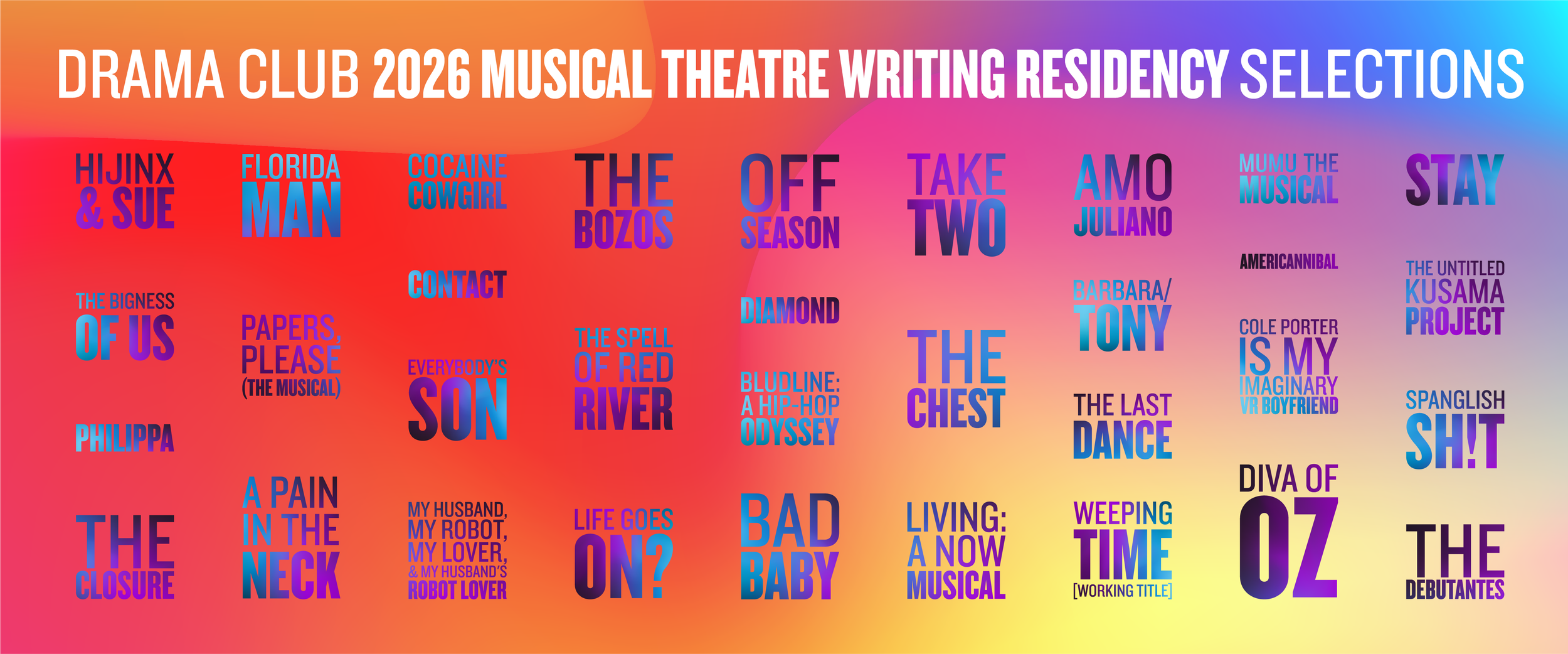
Drama Club, the world’s most prolific engine for developing new musical theater, is proud to announce the official artist selections for its 2026 summer residencies at Drama Club Camp. Chosen from an unprecedented pool of applicants - representing a staggering 227% increase over last year - this year’s pool reflects a massive global demand for high-level creative development.
As the industry’s largest developer of new musicals, Drama Club continues to redefine the musical theater landscape. A residency at Drama Club Camp is the cornerstone of a comprehensive ecosystem that also includes our International Fellowship, our Drafts reading series, and our consistent track record of well-produced developmental workshops and world-premiere productions. By providing a place for these new musicals to grow, Drama Club reinforces its commitment to moving stories from the page to the global stage.
Drama Club Camp is a one-of-a-kind creative haven designed intentionally for musical makers that offers:
65 acres on the shore of Torsey Lake in Mount Vernon, Maine
A century-old 14-bedroom lodge (Drama Clubhouse) with a Steinway baby grand, three fireplaces, an open bar, and private bedrooms with queen beds and electric pianos
Multiple private, quiet, rehearsal/writing spaces with electric pianos, instruments, printers, wicked-fast WiFi, and every tool a creative team could hope for
New in 2026: a state-of-the-art recording studio with all the equipment needed to make high-quality demos
Miles of hiking trails, secret art installations, hidden glens, Frog & Toad Pond, a lakeside firepit, and endless inspiration
The 2026 selections represent a vibrant tapestry of genres and perspectives. From hip-hop odysseys and VR-inspired comedies to historical epics and modern satires, the strength of craft in the material submitted this year was at an all-time high. These works tackle themes of identity, technology, and legacy, offering a bold look at the future of the medium.
Writers in this year’s class have been produced on stages around the world, and includes winners of nearly every major plaudit in the industry, including the Larson, Kleban, Rodgers, Obie, Broadway World, Princess Grace, Emmy, ASCAP Cole Porter, and Ebb awards; residencies at Cove Park, The Johnny Mercer Grove, Rhinebeck, The O’Neill, and Barn on Fire; and honors including Dramatist Guild Fellowships; Disney Imagineering’s New Voices Program; Sundance; MTI Stiles & Drew Prize; NAMT; Write Out Loud!; MSU New Musicals Lab; and many, many more.
"A 227% jump in applications is a clear signal that the creative community is in a period of immense output," says Scott Ihrig, Drama Club founder and Executive Producer. "We are honored to support these diverse voices at Drama Club Camp as they craft the next generation of the musical theater canon.”
“It’s getting harder and harder for new musicals to find a home on professional stages," says Founding Artistic Director Shannon Morrison. "That’s why we’ve built something so ambitious—we want to champion more writers and more diverse stories than ever before. It’s not just about the big names; it’s about giving 'unknown' artists the tools to level up. Because of the scale we operate at, we can take chances on people the rest of the industry might overlook.”
Five week-long cohorts of 13 artists each will begin in June and continue through August.
The 2026 Drama Club Camp Residency Selections:
A Pain in the Neck – Erin Reifler & Zonia Tsang
Americannibal – Nick Jonczak & Laura Lizcano
Amo Juliano – Fouad Dakwar
Bad Baby – Aaron Jafferis & Dahlak Brathwaite
barbara/tony – Adam J. Rineer
BLUDLINE: A Hip-Hop Odyssey – Pete White & Fermin Suero Jr.
Cocaine Cowgirl – Roni Nicole & Indigo
COLE PORTER IS MY IMAGINARY VR BOYFRIEND – Charles Gershman & Dylan Schifrin
Contact – Eric Ulloa & Brett Ryback
Diamond – Morgan J. Smart & Crystal Moneé Hall
Diva of Oz – Deborah D.E.E.P. Mouton
Everybody's Son – Alric Davis & Aaron Alon
FLORIDA MAN – Nico Raimont & Saúl Nache
Hijinx & Sue – Jessi Pitts & Daniel Wolfert
Life Goes On? – Damian Barray
Living: A Now Musical – Taylor Fagins & Michelle Kuchuk
Mumu The Musical – Saeed Malami & Dolapo Akinkugbe
My Husband, My Robot, My Lover, & My Husband's Robot Lover – Steven James Schmidt & Andrew Moorhead
OFF SEASON – Selda Sahin, Derek Gregor & Andrew Coopman
Papers, Please (The Musical) – Julia Barry & Daniel Nagler
PHILIPPA – G. Victoria Campbell & Stephanie Henry
SPANGLISH SH!T – Samora La Perdida, Mobéy Lola Irizarry, Josiah Handelman & Matthew Zwieibel
Take Two – Leta Harris Neustaedter
The Bigness of Us – Jord Liu
The Bozos – Adam Gwon & Michael Mitnick (Commissioned by Roundabout Theatre Company)
The Chest – Charles Inniss & Christopher Inniss
The Closure – Dylan Thompson, Matt Sav & Molly Lyons
The Debutantes – Sam Norman & Eliza Randall
The Last Dance – Josh Walker
The Spell of Red River – EllaRose Chary & Brandon James Gwinn
The Untitled KUSAMA Project – Andrew Strano & Yuriko Shibata
WEEPING TIME [working title] – Postell Pringle
About Drama Club
Drama Club, led by Artistic Director Shannon Morrison and Executive Producer Scott Ihrig, is the world’s most prolific developer of new musicals. Through their uniquely situated and deployed resources, they move work through development phases in flexible, responsive, and focused ways. Beginning with their cornerstone offering of annual residencies at Drama Club Camp in Mount Vernon, Maine, Drama Club brings writers and their pieces through development, including readings, workshops, collaborations, and productions. Currently repped on the boards by: Mexodus; CATS: The Jellicle Ball; Upcoming: Wanted; The Fitzgerald’s of St. Paul; Past: DRAG: The Musical; A Strange Loop. In Development: DISCOVERY; The Ascendants
The Commercial Musical Takeover: A New Resource for Producers
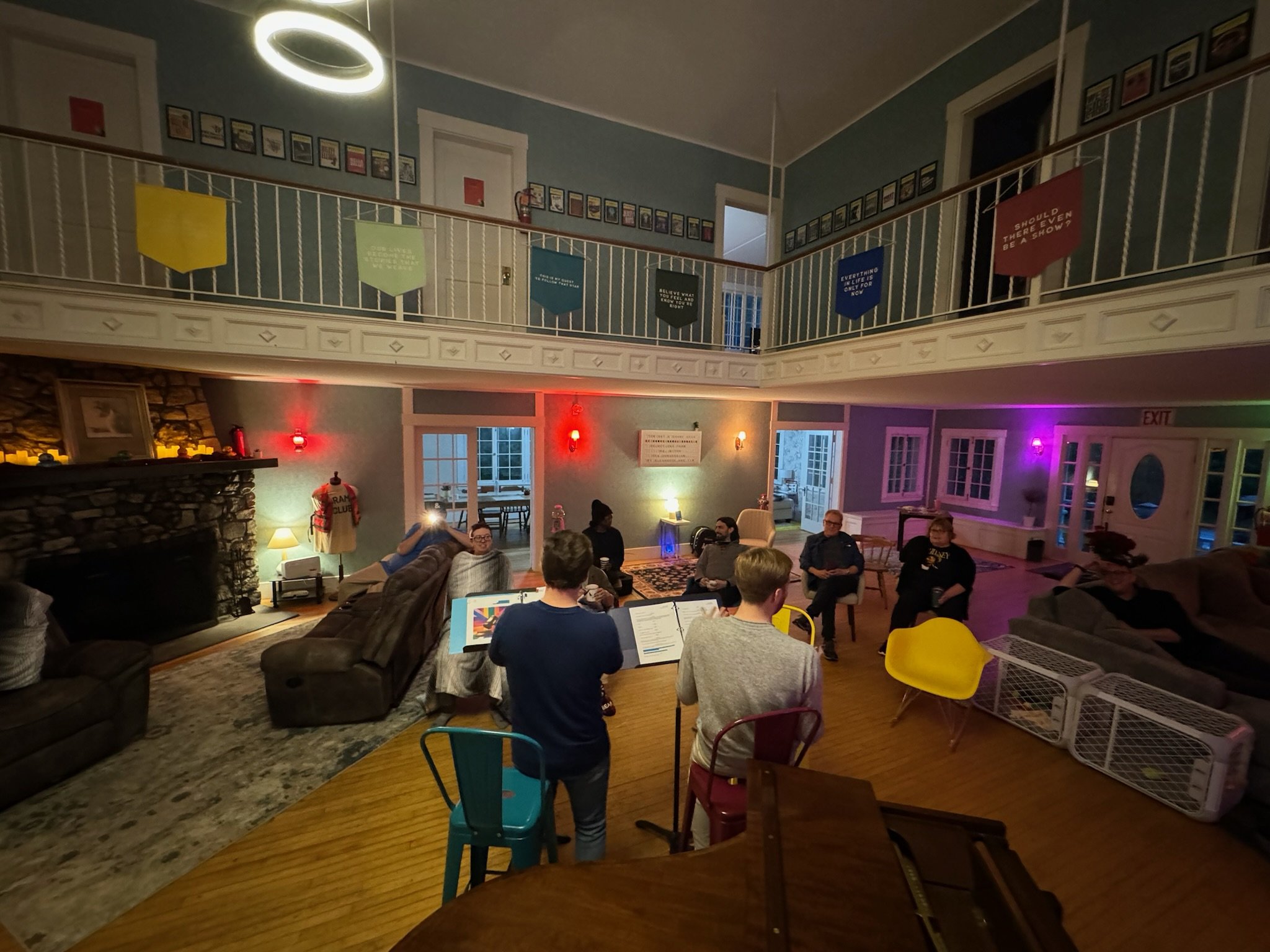
I’ve been in the trenches of big-budget commercial development, and I’ve seen firsthand how the traditional development model bleeds a production dry before it even reaches a stage.
Years ago, while I was working on a certain pink-hued Broadway show, I remember the sheer, exhausting absurdity of the logistics. We were trying to build a massive, high-stakes musical in the middle of Manhattan, with a creative team that resided anywhere else, which meant I was playing travel agent instead of producer. I was constantly hunting for Airnbnbs for the creative team, often shipping them off to the Hamptons just to find a space that could house the group. These weren't just astronomically expensive; they were inconvenient, overpriced, and lacked some of the basic stuff needed to write musicals, like pianos and recording equipment. It was logistical friction in its purest form, and it was draining the creative battery and bank account of the show.
That experience is exactly why we built the Commercial Musical Takeover at Drama Club Camp.
Eliminating the “Hamptons Tax"
A Commercial Takeover is a full-scale occupation of our campus. It is a concentrated, high-stakes residency designed for shows that need to gather a larger group together to solve big problems.
When a production initiates a Takeover, we eliminate the friction that plagued my time on the pink show:
Concentrated Development: Instead of managing the logistics of a workshop in a pricey time-restricted midtown rehearsal studio, witha hotel room block, per diem, and the entropy of commutes, it’s all just DONE. You wake up, ready to work, until you go to sleep. One week on campus is equivalent to months of fragmented development because the barriers—the commutes, the noise, the logistical stress—have been removed.
Drama Club Camp: We provide a state-of-the-art infrastructure where teams live, eat, and breathe the project. This is a space for deep work, where the breakthroughs happen at the breakfast table or during a late-night walk, not just during rented hours at New 42.
Strategic Alignment: We align our resources and our understanding of theater-making to give your show exactly what it needs… whether a choreography workshop, a dramaturgical intensive, or a workshop before an industry presentation. You aren’t just renting a room; you are gaining a partner dedicated to your show's success.
A Summer of Takeovers
The proof of this model is in the demand. This summer, the Drama Club Camp campus will be fully transformed as we host four major commercial productions as they prepare for commercial bows.
These teams are utilizing the whole campus—every studio, every acre, and every bed - to strip away the noise of the city and find the focus and freedom that their shows deserve. They aren't interested in being travel agents and company managers; they are coming to Camp to do the essential work of readying your show for the next stage.
Take Over the Future
The old way of working relies on you staying spent, stressed, and distracted by the financial and logistical hurdles of working in the most expensive place on the planet. Our Commercial Musical Takeover invites you to be bold, focused, and relentless.
If you are a lead producer who is tired of spending your budget on hotel rooms and rehearsal studios, it’s time to move out of the city and get upta Drama Club Camp for a week or two.
For more information on Commercial Musical Takeovers, click CONSPIRE at the top of this page or email takeovers@drama.club.
Your Show is a Script. Your Pitch Deck is a Business Plan.
Pitch decks are important. Here’s how to make one…
In my first post, I gave you some tough love: I don’t care how good your songs are if you can’t tell me why the show is relevant. But once you’ve figured out your why, how do you communicate it to a producer who has 50 other scripts sitting on their desk? You don't send them a 120-page PDF of the script and a Dropbox link to 18 demos. Not yet.
You send them a Pitch Deck.
What is a Pitch Deck (and Why Does it Exist)?
A pitch deck is a visual document (usually 10–15 slides) that tells the story of your show, its commercial potential, and its artistic soul.
Producers are visual creatures. They are also busy. A pitch deck allows them to "see" the production, understand the vibe, and grasp the logistics in five minutes or less. If the deck is successful, it earns you the right to have them actually read the script.
The Anatomy of a Winning Pitch Deck
If you’re staring at a blank slide template, here is exactly what you need to include to get noticed by someone like me:
1. The Hook (Slide 1-2)
Start with a high-impact image and your Logline.
Bad: "A musical about two people who fall in love in New York."
Good: "A high-stakes, live-looping exploration of the Southern Underground Railroad." (See: Mexodus).
Include a one-paragraph synopsis that focuses on the conflict and the stakes.
2. The Why Now? (Slide 3)
This is the Narrative of Relevance. Why does this story need to be told in 2026? What is the editorial point of view? If you can't answer why the world needs this show today, a producer won't be able to sell tickets to it tomorrow.
3. Character & World (Slides 4-6)
Don't just list names. Use comps or archetypes. Describe their vocal style. Use imagery that evokes the setting. If it’s a period piece, show us the grit; if it’s a fantasy, show us the magic.
4. The Music (Slide 7)
Don't just say "Pop/Rock." Be specific. "A fusion of 90s R&B and contemporary folk."
Pro Tip: Embed a Spotify playlist or a Soundcloud link directly into the deck. Make it easy for them to hear the sound of the world.
5. The Creative Team (Slide 8)
Who are you? What have you done? If you’re a new writer, focus on your perspective and your training. If you have a director or a name attached, highlight them here.
6. Development History & Goals (Slide 9)
Where has the show been? (Readings, workshops, Drama Club Camp?) And more importantly: What do you need next? Are you looking for a Lead Producer? A regional premiere? $50k for a 29-hour reading? Be specific.
Practical Instructions: Do's and Don'ts
DO
Use High-Quality Visuals. Mood boards are your friend.
Keep Text Minimal. No one wants to read a novel on a slide.
Check Your Formatting. Align your text; use consistent fonts.
Make it a PDF. Never send a Powerpoint or a Keynote file.
DON’T
Use Clip Art. It looks amateur and kills the vibe.
List Every Song. Just highlight the 3-4 tentpole numbers.
Assume they know the source material. Explain it simply.
Don’t forget your contact info. Put it on the last slide!
The Drama Club Perspective
We love pitch decks. They help us see if the writer understands the editorial nature of our art form.
A deck isn't selling out - it's leaning in. It shows me that you respect the producer's time and that you have a clear vision for how your show occupies space in the market.
Lastly, we are unfortunately in a development world where shows need to be socialized for years before a production will be considered. Having a deck early in the process can help you start that socialization. Just make sure you keep it current
Is your deck ready to be seen? If not, stop writing lyrics for an hour and start designing your future.
The Paperwing Lesson: Why the Local Ecosystem is the Heart of the Form
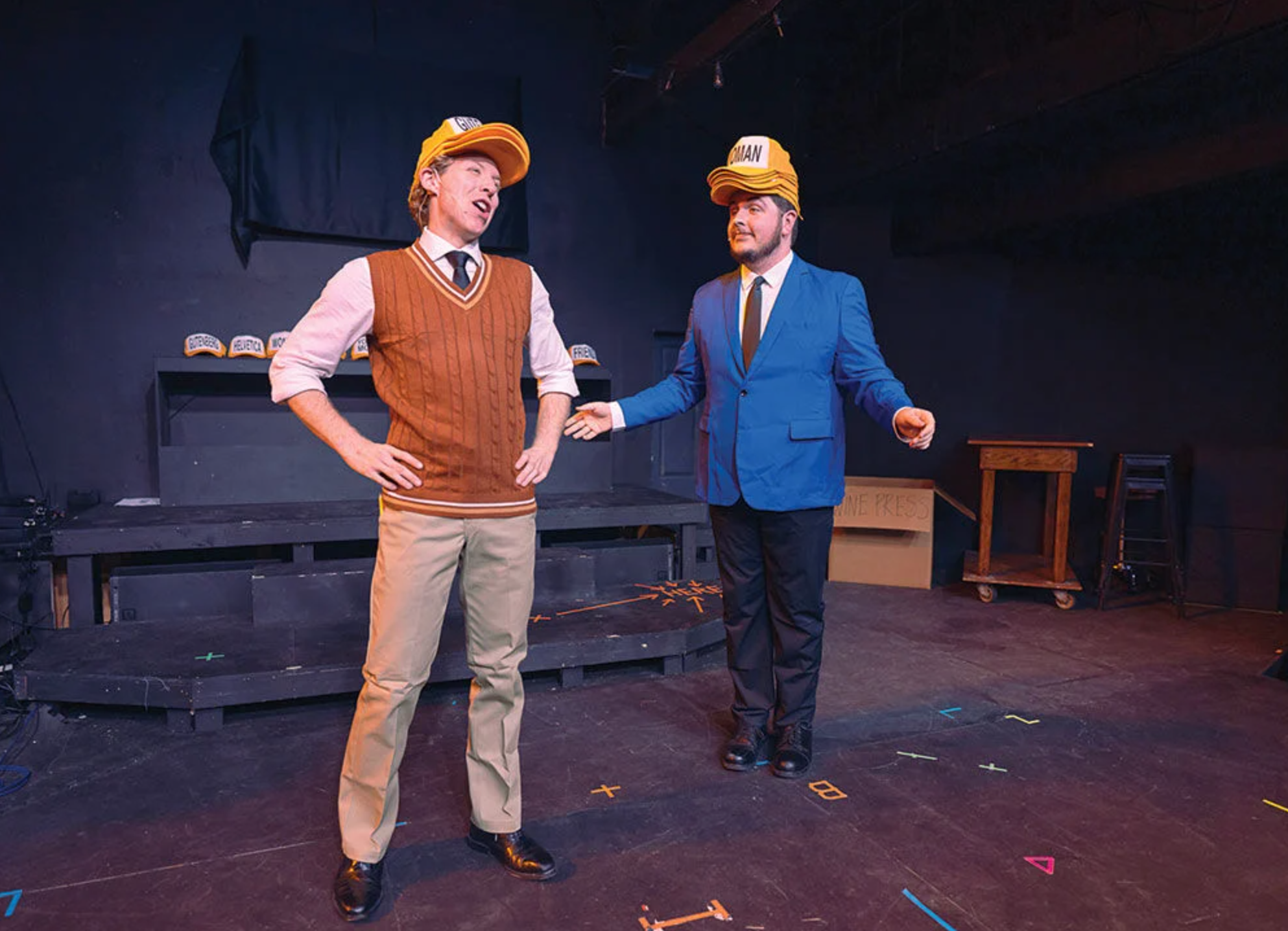
Brian Steen-Larsen & Hunter Powers star in Gutenberg! The Musical! at Paperwing through February 15th. Photo: SARAH GAUDOIN of Monterey County NOW
I spend a lot of my life in windowless Midtown rehearsal studios talking about "commercial viability" and "developmental roadmaps." But this past week, I stepped away from the noise of the city and found myself in Northern California at Paperwing Theatre, watching a production of Gutenberg! The Musical!
It was exactly the soul-refreshing experience I needed.
The Fire in the Craft: Brian and Hunter
It is one thing to see a seasoned Broadway veteran hit a high note for the thousandth time; it is another thing entirely to watch artists at the beginning of their journey discover the power of their own voices.
I want to call out the two leads, Brian Steen-Larsen and Hunter Powers. Watching them tackle the relentless, high-energy comedy of Gutenberg was a masterclass in passion. There is a specific kind of electricity that happens when performers like Brian and Hunter give everything they have to a role—a raw, infectious joy that reminds you why we fall in love with theater in the first place. They weren't just "performing" for us; they were sharpening their tools and developing their craft in real-time. It was a privilege to witness that spark.
The Galvanizing Force
As I sat in that room, I was reminded that theater is a social technology before it is a commercial one. Its primary function is to bring people together and remind them that they aren't alone.
Paperwing is doing the vital work of building a collective:
It is A Hub for the Arts: I saw a community of local arts lovers who were there to support the lifeblood of their own town.
It is A Training Ground for Artists: Passionate artists learn confidence and gain their sea legs, a rite of passage for every single artist ever.
It is A Safe Haven: I saw a space where the outsiders and the queer community feels safe, seen, and celebrated. In 2026, that kind of radical belonging isn't just a "nice to have" - it’s a necessity.
The Investor as a Patron of the Soul
My friend and fellow Broadway producer/investor, Koly McBride, has been a driving force behind the work at Paperwing. Seeing her in her home environment reminded me that "investing" in theater isn't always about the bottom line of a pro-forma.
People like Koly and her partner Lloyd are investing in cultural health. They understand that by building a local stage, they are providing a training ground for the next generation of professionals - the future Brians and Hunters - and a sanctuary for the community. Koly’s commitment to Paperwing is a reminder that being a "producer" is about the people you lift up, whether that’s on 42nd Street or in a dinner theater in Northern California.
Why Paperwing Matters
It is easy to get caught in the bubble of high-stakes development. But Paperwing reminded me that the "Woodshed" space we create in Maine - that place of deep work and discovery - exists in spaces even farther from NYC than rural Maine.
We need these theaters to keep the fire burning. They are the soil from which the future of the American Musical grows.
To Brian, Hunter, the crew, and the leadership at Paperwing: Thank you for the joy, the safety, and the reminder of why we do this.
Keep building. The industry is stronger because of you.
NASA Challenger Tragedy

The crew of the space shuttle Challenger. Front row from left are Michael Smith, Dick Scobee and Ronald McNair. Back row from left are Ellison Onizuka, Christa McAuliffe, Gregory Jarvis, and Judith Resnik.
Today marks the 40th anniversary of the ill-fated NASA Space Shuttle Challenger mission. Like many, I remember exactly where I was as the nation watched the launch together. What I was too young to grasp is the devastation that tragedy brought to NASA itself, and especially the astronaut corps - seeing their friends perish and the institution they trusted with their lives fail before their eyes in the matter of moments.
A year and a half ago, authors Alex Higgin-Houser and Dan Gibson shared with Shannon and me the beginnings of Discovery: a musical telling the story of the NASA astronaut corps after the Challenger tragedy of 1986 and the lead-up to the 1988 launch of Space Shuttle Discovery. Based on interviews with astronauts, it dives deep into how catastrophe and grief can catalyze self-discovery, reinvention, and healing.
I’ve had the honor of collaborating with them in developing Discovery, and I look forward to doing my part to share this story with the world.
Take a listen to an early version of the opening of the show: the launch of Challenger, now forty years ago today.
Radical Specificity is better than Inclusion
Drama Club has thoughts. Check them out on our blog.
I’m going to say the quiet part out loud: "I want to see representation" is a motivation, but it is not a creative pitch. In today's climate, we see a lot of "checklist theater" - shows that feel like they were written by a committee looking to satisfy a diversity report. This kind of inclusion for the sake of a photo op is, frankly, boring. It results in "general" stories that try to represent everyone and end up moving no one.
Radical Specificity is the antidote. Look at the shows that are actually changing the landscape. The Jellicle Ball and Mexodus don’t succeed because they "check boxes." They succeed because they are so deeply, unapologetically specific to a time, a place, and a culture that they become universal. When you write the "dangerous" details—the specific rhythms of a neighborhood, the unique syntax of a family, or the precise, localized joy of a specific community, you stop being a "representative" and start being a storyteller.
The Lesson for Writers: Stop trying to write the "universal" version of your experience to make it "accessible." Accessible is just another word for diluted. Write the show that you see, with such vivid, radical detail that we have no choice but to learn your language. That is how you transcend the individual. The more specific you are, the more room there is for an audience to find themselves in the truth of your work.
Freedom Flows South: The Return of MEXODUS to the Daryl Roth Theater
Mexodus is returning to the Daryl Roth Theatre on March 6!
Every so often, a piece of art comes along that is so undeniably vital, so structurally innovative, and so politically defiant that it forces the industry to pay attention.
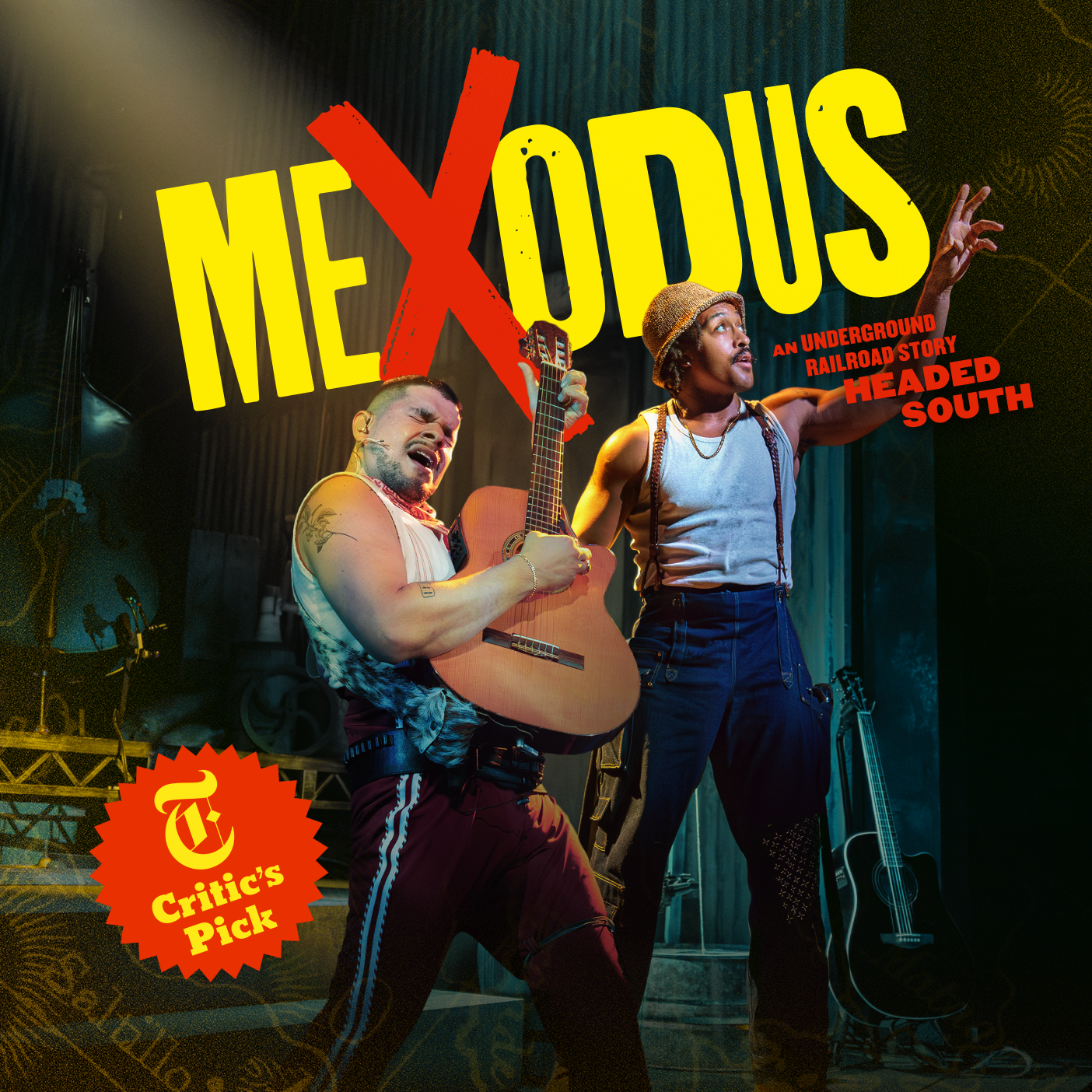
That piece of art is MEXODUS. And this spring, we are thrilled to help our friends at P3 Productions bring Brian Quijada and Nygel D. Robinson’s masterpiece to the Daryl Roth Theater.
The Story We Weren't Taught
Relevance is vital, and Mexodus is the definition of it. While our history books focus on the Underground Railroad running North to Canada, there was another path - one that led South.
Between 1829 and 1865, thousands of enslaved people crossed the Rio Grande into Mexico, where slavery had already been abolished. Mexodus tells this story through the fictionalized bond between Henry, an enslaved Black man from Texas, and Carlos, a Mexican sharecropper. It is a story of Black and Brown solidarity that transcends borders, history, and the traditional "musical theater" box.
Innovation, Looped
Mexodus isn't just a history lesson; it’s a technical marvel. Brian and Nygel are a two-man orchestra, utilizing live-looping technology to build a massive, hip-hop-infused score in real-time.
This piece is innovative in so many ways, but here are just a few of the reasons Drama Club is onvolved with Mexodus.
It’s lean: Two performers, one stage, and a "junkyard" of instruments.
It’s virtuosic: It requires a level of skill—from acting to audio engineering—that most "safe" commercial shows wouldn't dare demand.
It’s editorial: It doesn't just ask us to look at 1829; it asks us to look at the border agents and racial "hunting" of 2026.
This production represents the "accelerated" future we want for the industry. It’s Black, it’s Brown, it’s loud, and it is a direct challenge to anyone who says that "challenging" stories don't sell.
Join the Movement
This show is protecting a hidden history, and proving that you don't need a twenty-million-dollar budget to make an audience's heart explode with pride and perspective.
MEXODUS begins looping again March 6 at the Daryl Roth Theater. Go to MEXODUSmusical.com for tickets.
Top 5 Trends from 2026 Camp Submissions
Drama Club seeks out black, latiné, LGBTQIA+, and emerging writers to host at Drama Club Camp, our annual Musical Theater Writer Residencies in Mount Vernon, Maine.
While our application pool represents merely one self-selected group of writers, there are notable trends to be gleaned from the nearly 300 submissions we received this year. Here are a few of those trends!
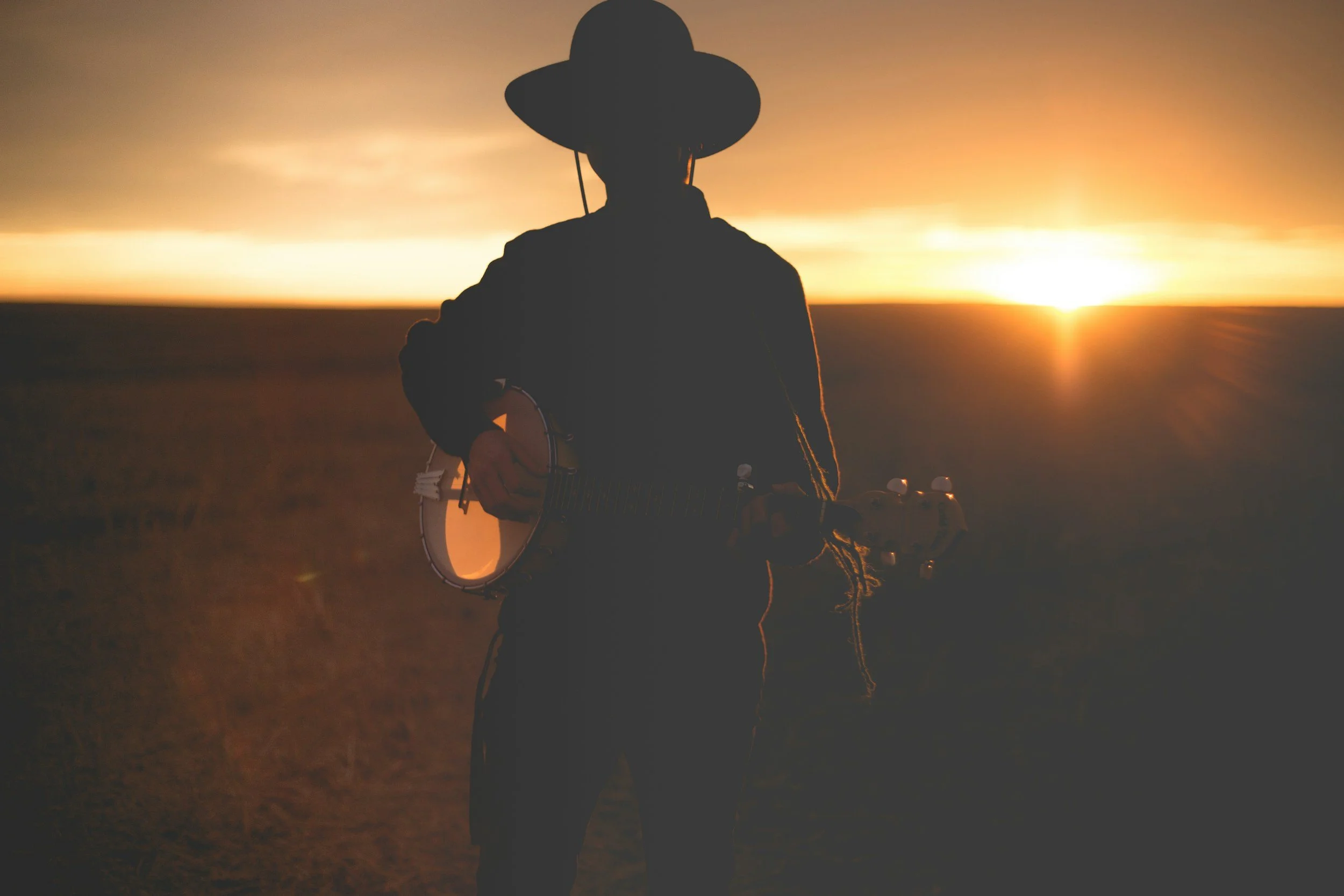
Drama Club seeks out black, latiné, LGBTQIA+, and emerging writers to host at Drama Club Camp, our annual Musical Theater Writer Residencies in Mount Vernon, Maine. While our application pool represents merely one self-selected group of writers, there are notable trends to be gleaned from the nearly 300 submissions we received this year. Here are a few of those trends:
Westerns.
There’s something in the zeitgeist that is leading writers to examine the rules and customs of the Old West. Many of the submissions using this setting/genre are doing so in subversive ways, highlighting queer narratives or black narratives within the historically straight white genre. What is it about the Old West that is speaking to us as artists? Perhaps the upcoming Broadway show WANTED will offer us an answer, as it seems to be the next best example of this genre. Can’t wait!
Immigration & Fascism Narratives.
Theater is where political activism happens, and this year, the political conversations in submissions were largely about Fascism and Immigration. Whether through the lens of a Game of Thrones-style political fantasy or an intimate, contemporary love story, theater artists are trying to make sense of a world that doesn’t make sense. Theater is a great place to do that, particularly when it allows the complexity of these issues to be examined rather than simplified.
Writing for the perception of what a non-profit theater wants (i.e., 2-5 person cast).
An overwhelming number of writers, when talking about why they are writing something, cited economic conditions facing small, regional, and non-profit theaters. Given that this is where most new work finds its sea legs, writers are creating work that they think theaters want - tiny, 2-5 person musicals. And yet… I wonder… is that really what these theaters want? Are writers making a presumption about what their buyers want? How can we get better information about what theaters want writers to be creating for audiences? As Exhibit A: point to five theaters that are programming a new musical every season. Is it a tiny show? Do those theaters even exist?
Emerging and formerly young writers from the COVID era are struggling to find footing.
There’s been much discussion at Drama Club about what it means to be emerging, and how there is a youth bias in much of the support provided to emerging writers. We are seeing a significant preponderance of writers in their mid-to-late 30s who were the ascendant class of Larson/Ebb/O’Neill/NAMT winners, and whose careers were stunted by COVID-19. These writers watched their careers screech to a halt, and when the world returned, attention had already shifted to the never-ending line of new, fresh-faced winners for producers to try and monetize. These incredibly talented writers are left wondering, 'What do I do now?' I’m still emerging, but I’m not a kid. These writers are RIPE to work hard and create excellent work. I’m leaning into them.
No one knows where they are going with their show besides a reading.
I ask writers what the pathway they aspire to for their show, and almost every answer is the same, “We are working to finish things in preparation for a 29-hour in the fall.”
Is the 29-hour reading the only way we develop work? Does it always have to cost 20-50K? Do writers understand that it costs that much? Do writers know what they want to get out of a reading? Is it always for producers? Is the reading itself the goal for the show? What else is there, either instead of or after a 29-hour reading?
So how might formerly young yet still emerging writers find footing? Where do we go other than a reading? What do regional non-profits actually want? How do we know? How do writers create of-the-moment work when it takes eight years to reach a stage? These and other questions are some that I’ll unpack in the coming weeks as I continue to evaluate writers for Camp 2026. I’ll also be announcing the 2026 Campers on March 1 at Drama.Club!